Shopify Shipping Costs Causing Checkout Abandonment? Fix the Surprise Without Killing Margin
Shopify buyers leave at shipping? Diagnose rate surprises, show delivery costs earlier and calculate a free-shipping threshold without erasing profits.
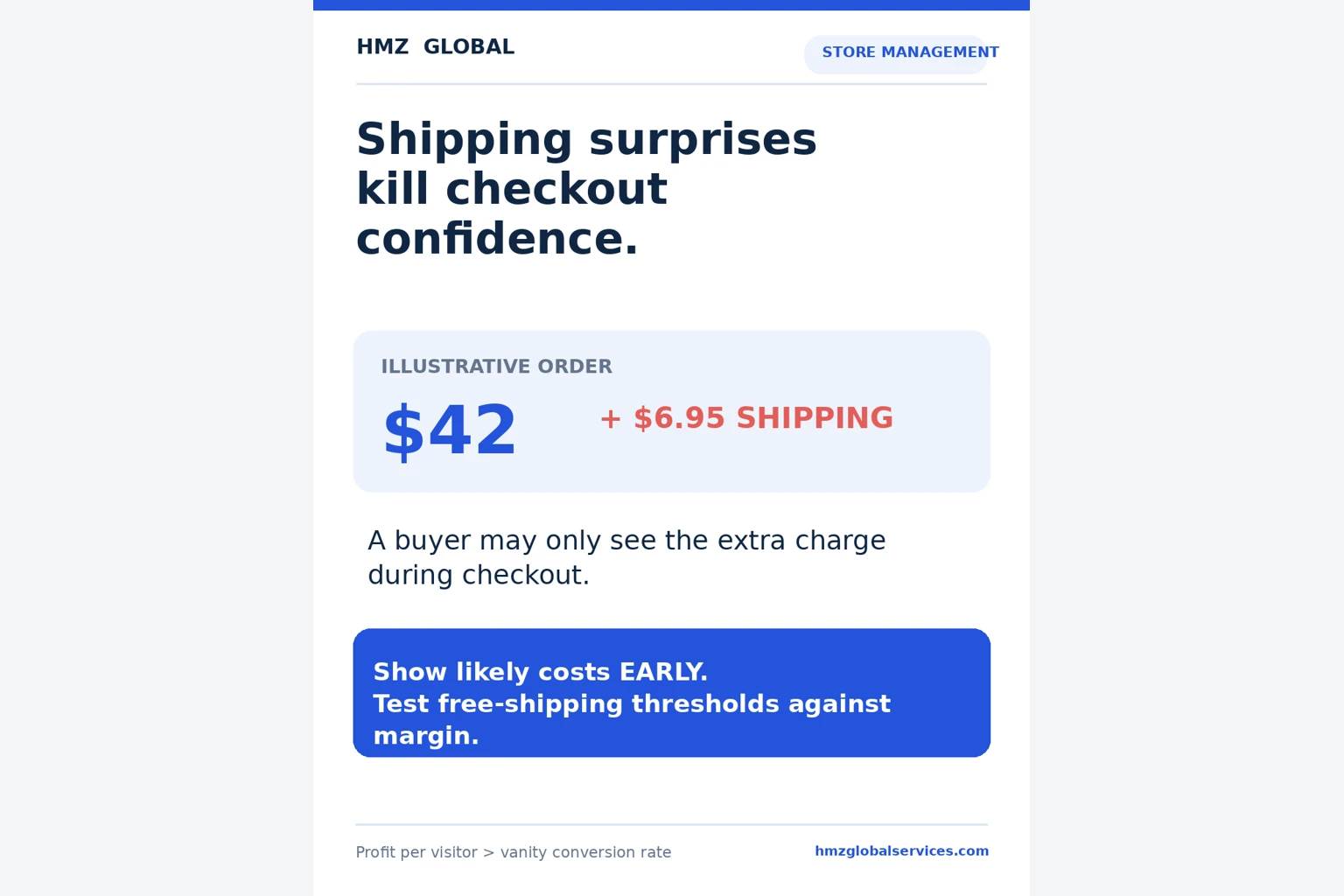
A customer adds a product, begins checkout, sees an unexpected shipping charge and leaves. Offering free shipping can reduce the surprise—but giving it away without checking contribution margin can turn a conversion problem into a profitability problem.
The better fix starts with clarity: display a reliable estimate early, make delivery options intelligible, and model whether changes to shipping pricing actually improve profit per visitor, not only checkout conversion.
Shopify's guidance recommends showing costs and delivery timing early. Its October 2026 cart-abandonment article reports extra costs as a leading fixable abandonment reason in cited Baymard research, but that statistic is a survey result, not the abandonment rate of your store. Shopify: Reduce Shopping Cart Abandonment.
1. Establish that shipping costs really are the problem
Look for evidence rather than guessing. Compare sessions and funnel progress from product views to add-to-cart, checkout initiated, shipping step, payment and purchase. Segment by mobile/desktop, country, advertised product and shipping method.
A sharp decline after shipping options become visible suggests a plausible shipping-friction hypothesis. It does not prove causation: delivery dates, payment methods, stock surprises and poor mobile performance can all contribute. Shopify's checkout analytics, store reports and session testing can help you narrow the issue. Review our existing Shopify traffic but no sales diagnosis for the wider funnel.
Before changing settings, run a test purchase from a key customer region using a real cart. Capture: product-page estimated delivery, cart-level disclosure, checkout shipping quote, tax/duty treatment and final total. Repeat for a light item, a heavy item and a mixed cart.
2. Four ways to remove shipping surprises
| Approach | Benefit | Commercial risk | Best when |
|---|---|---|---|
| Display estimated shipping on product/cart | Buyers see the likely total earlier | Quote may differ for remote destinations or mixed carts | You can provide a trustworthy estimate |
| Offer a simple flat rate | Easy to understand and advertise | Undercharging expensive destinations | Parcel costs have manageable variation |
| Offer free shipping above a threshold | Encourages some buyers to add items | Extra goods and shipping may absorb margin | Add-ons have positive contribution |
| Pass through carrier-calculated rates | Better protects shipping cost recovery | Exact rate may appear late and surprise buyers | Rates vary widely and transparency is handled elsewhere |
Shopify Help: Creating a Shipping Strategy describes flat, free and carrier-calculated rates and warns that calculated rates visible only at checkout can surprise shoppers.
Make the total visible early
On product pages, use an honest delivery estimate or a clearly labeled range. In the cart, show the applicable threshold and common shipping charges. Avoid banners promising “FREE SHIPPING” if the offer excludes countries, oversized goods or specific products; state those limitations clearly.
Make a free-shipping threshold about contribution, not vanity order value
Consider an illustrative order:
| Item | Standard order | Order with add-on to unlock free shipping |
|---|---|---|
| Product revenue | $42.00 | $54.00 |
| Customer shipping collected | $6.95 | $0.00 |
| Product cost | -$18.00 | -$23.00 |
| Pick/pack | -$2.00 | -$3.00 |
| Carrier cost | -$8.00 | -$8.00 |
| Payment fees (illustrative) | -$1.50 | -$2.00 |
| Contribution before ads, returns and overhead | $19.45 | $18.00 |
A “free shipping on $50+” threshold made the order $12 larger but $1.45 less profitable in this example. The customer bought more, yet the merchant gave up the $6.95 shipping contribution and incurred extra cost. That does not mean thresholds never work; it means the threshold, add-on cost and expected conversion lift need testing.
Contribution formula: product revenue + shipping collected − product costs − fulfillment/packaging − carrier shipping − payment fees − other variable costs. Include returns, ad costs and applicable taxes separately before deciding on true profitability.
3. How to test a better rate strategy
Pick one clear hypothesis, such as “Showing estimated shipping on the cart reduces checkout-start drop-off for US mobile buyers.” Keep the experiment narrow so you can interpret it. Test two shipping presentations or thresholds on comparable traffic, as permitted by your store setup and experimentation tools.
Track:
- Checkout-to-purchase conversion, not just cart additions.
- Revenue and contribution per visitor (including the shipping subsidy).
- Average order value, units per order and discounts used.
- Real carrier cost by destination and package size.
- Customer support queries about delivery charges and timelines.
If the test increases conversion but meaningfully reduces contribution per visitor, it may not be an improvement. Evaluate over enough eligible traffic to reduce random fluctuations; low-traffic stores can take longer to learn.
4. Fix common Shopify configuration errors first
Wrong product weights: carrier quotes become inflated or inaccurate if weights are missing or package weights are incorrect.
Misconfigured shipping zones: buyers may see no available rate or rates intended for another market. Check the actual destination countries and regions.
Split fulfillment locations: carts drawing inventory from multiple origins can produce unexpectedly high combined shipping. Test mixed carts and location routing.
Unclear taxes or import costs: cross-border buyers need to know whether duties/taxes are collected during checkout or at delivery. Do not imply DDP when the seller is not responsible for import clearance.
Slow or ambiguous delivery: displaying a price without a reliable delivery window still leaves uncertainty. Show processing time and estimated transit time separately where possible.
5. A simple operational checklist
- Test checkout for your three largest destination markets using realistic carts.
- Verify weights, package dimensions, rate profiles and applicable zones.
- Show an honest shipping estimate before the payment step wherever feasible.
- Make delivery dates and free-shipping exclusions visible before checkout.
- Compare contribution per visitor, not only order count.
- Re-run the test after changing product prices, carriers or warehouses.
The objective is not “zero shipping charge.” It is predictable customer expectations and profitable orders.
If you need help reviewing store operations and advertising economics, see HMZ Global Store Management or send a project brief.