Factory Audit vs Pre-Shipment Inspection in China: Which Do You Need?
Factory audit or pre-shipment inspection in China? Compare what each checks, when to book it, evidence to request and the limits of each service.
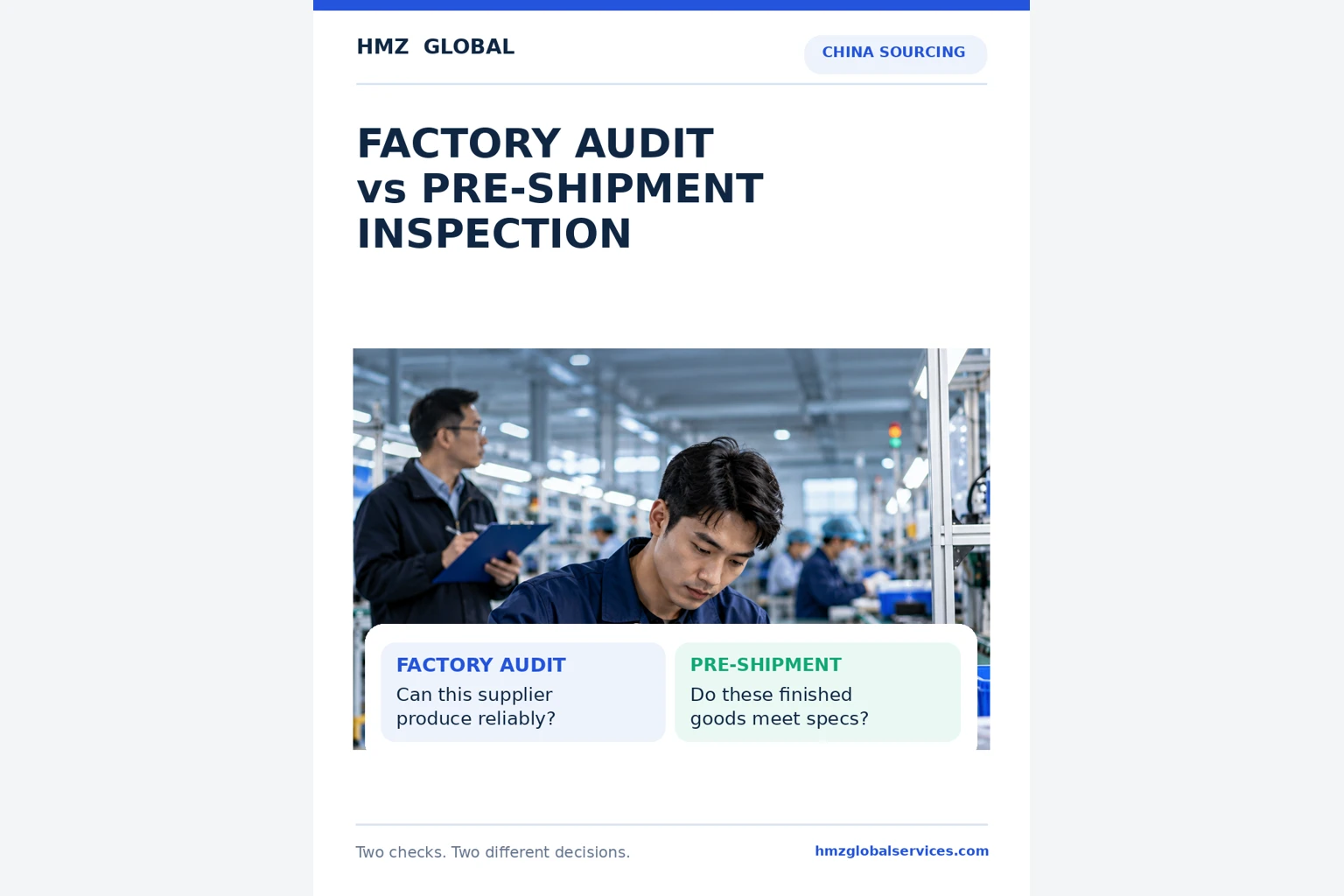
An audit asks whether a factory has the people, equipment and processes to make your product reliably. A pre-shipment inspection asks whether a specific finished order meets your agreed requirements. They are separate decisions. Buying only one can leave the other risk unaddressed.
Suppose a buyer places an order for 2,000 branded electric desk lamps. The supplier sends impressive factory photographs and a business licence. Does that prove its factory can sustain production? No. Does an attractive audit report prove the 2,000 lamps about to ship have the correct power adapters, labels and finish? Also no.
The practical question is not “Which inspection is best?” but “What decision am I making next, and what evidence would justify it?”
Quick comparison
| Issue | Factory audit | Pre-shipment inspection (PSI) |
|---|---|---|
| Main decision | Approve supplier/site capability | Accept, hold or correct a particular order |
| Typical timing | Before onboarding or scaling production | Near completion, before dispatch and preferably before releasing balance payment |
| Main object | Factory systems, personnel, equipment, production records and capacity | Finished units, workmanship, quantities, packaging, labeling and agreed tests |
| Evidence | Site observations, process/quality-system documents, capacity checks, corrective-action plan | Sampling plan, test/measurement results, defect records, photographs and shipment disposition |
| Does it certify every product? | No | No; a sample inspection is not a 100% check |
| Most common mistake | Treating audited capacity as proof of delivered quality | Treating a passed batch as evidence the supplier is a reliable factory |
The distinction aligns with how inspection companies such as QIMA separate manufacturing audits from product inspections. QIMA: Manufacturing Audit.
1. What does a China factory audit actually check?
A manufacturing or capability audit focuses on the real production site, not just the seller's Alibaba or 1688 storefront. Depending on the scope, an auditor may:
- Match the legal business entity, registered location and operating site; record unresolved mismatches.
- Check whether important production processes are performed on-site, subcontracted or bought in.
- Review critical equipment, maintenance arrangements, training and staffing adequacy.
- Examine incoming material controls, in-process checks, calibration and nonconforming-product procedures.
- Review capacity claims against realistic shift patterns, bottlenecks and recent production evidence.
- Assess the ability to meet product-specific requirements and any relevant documentation obligations.
A factory audit is not a universal certificate. A one-day visit cannot prove every claim, future capacity or compliance of a particular batch. A social-compliance or environmental audit is a different scope from a technical manufacturing audit. Request the module you actually need.
When it is useful: a first substantial order with an unfamiliar supplier, a complex custom product, a high-risk category, or a switch to a production site you have not evaluated.
2. What does a pre-shipment inspection check?
A PSI is a physical review of an identified order after sufficient goods are manufactured and available for checking. The inspection plan should reference your purchase order, approved sample, specification sheet and packaging artwork—not generic “good quality.”
For our illustrative lamp order, a proper brief might demand checks of:
- Quantity and identity: cartons, model and variation counts, order markings.
- Workmanship: visible defects, finish, damage and assembly.
- Specifications: dimensions, materials, connectors, color and tolerances.
- Function: switching, supplied power components and other agreed functional checks.
- Packaging: drop/handling requirements if specified, carton labels, barcodes and protection.
- Safety or compliance evidence: availability and traceability of relevant reports where required; a visual PSI does not replace accredited product testing.
A PSI normally uses sampling. Whether its sampling plan is statistically meaningful depends on lot size, acceptable quality limits (AQL), defect classification and the agreed inspection level. Do not advertise a sampled pass as “100% defect-free.” For a ready-to-use scope, see our pre-shipment inspection checklist.
3. Which one should you pay for? Decision matrix
| Buyer situation | First step | Why |
|---|---|---|
| Unknown supplier, expensive custom tooling | Supplier identity checks + targeted factory audit | Confirm the site and capability before committing substantial funds |
| Trusted supplier, repeat order, routine product | Order-specific PSI | Shipment conformity is the immediate decision |
| New factory, first high-volume batch | Audit and suitable production/PSI checks | Different layers of exposure |
| Time-sensitive packaging or labeling change | PSI with explicit revised artwork and carton checks | Last-minute changes create batch-specific risk |
| Defect-prone production where late fixes are costly | During-production inspection, then PSI if warranted | Find problems before the entire lot is made |
| Concern about wrong goods loaded into a container | Loading supervision | Loading control is separate from factory capability and a PSI |
A simple rule: if your concern begins “Can this factory…”, start with an audit. If it begins “Are these 2,000 units…”, prioritize a PSI. If you need both answers, commission both scopes or design a staged verification process.
4. A worked decision: $18,000 first order
Illustrative example only; no inspection-company quotation is implied. A buyer has a $18,000 initial order with a new supplier. The buyer cannot replace the goods quickly if defect rates are high or the factory is not capable of the product's custom finishing.
Before deposit: verify the business entity and site, then consider an audit centered on finishing, quality records, subcontracting and manufacturing capacity. Write contract requirements and retain the approved sample.
During production: review the first production sample or arrange a production check if the process is unstable.
Before balance and shipment: inspect the finished order using the product specification and approve any corrective actions. If the contract permits, release the remaining payment only after the agreed inspection gate is cleared.
Notice the tradeoff: paying for an audit alone could miss scratched products in the final lot; paying for a PSI alone could miss a hidden subcontracting or capacity risk until after the deposit is at risk.
5. What must be written into an inspection request?
Send the inspector an unambiguous brief with the supplier name and factory address, purchase order, quantities and variants, approved reference sample, measurable acceptance standards, defect classification, permitted tests, packaging rules and reporting deadline. Clarify whether testing is destructive, what equipment is needed, who pays any retest, and who has authority to approve rework or reject the batch.
Ask for raw evidence, not just a pass/fail badge: sample size, defect counts by class, photographs, tested specification points, test conditions, limitations and any inaccessible areas. Decide in advance how a failure leads to correction, reinspection or escalation. Inspection fees depend on location, scope, product complexity and added modules; there is no honest universal price.
6. Mistakes that make inspection money ineffective
- Booking too late. The goods may already be packed, shipped or paid in full.
- Inspecting the wrong specification. Quality is not measurable if your requirements were never written.
- Ignoring sampling limits. The remaining cartons may contain defects a small sample did not reveal.
- Assuming documentation equals production control. A legal business registration is not a capability audit.
- Treating a PSI as a laboratory test. Electrical, chemical and other regulated requirements can demand specialist testing.
- Failing to manage findings. A defect report without a corrective-action and payment decision provides little protection.
Our guide to checking a Chinese supplier's business licence covers the initial legal-identity layer, while the China sourcing guide explains how it fits into a purchasing workflow.
7. A concise supplier message
English: “Before we authorize production and final shipment, please confirm the factory address and whether any key process is subcontracted. We will share an approved specification and inspection checklist. Please confirm that our appointed inspector can access the relevant work areas and finished goods before dispatch.”
The bottom line
A factory audit reduces uncertainty about who and what is producing your goods. A pre-shipment inspection reduces uncertainty about the particular goods you are about to accept. Choose according to the exposure and stage of your order; do not confuse a report with a guarantee.
For supplier screening, bilingual RFQs or coordinated inspection, explore HMZ Global China sourcing services or send your project requirements.
Sources and further reading
- QIMA — Manufacturing Audit (factory capability and audit scope).
- CZ Overseas — Factory Audit or Pre-Shipment Inspection (comparison of decision stages).
- HMZ Global — Pre-Shipment Inspection Checklist (existing supporting guide).